

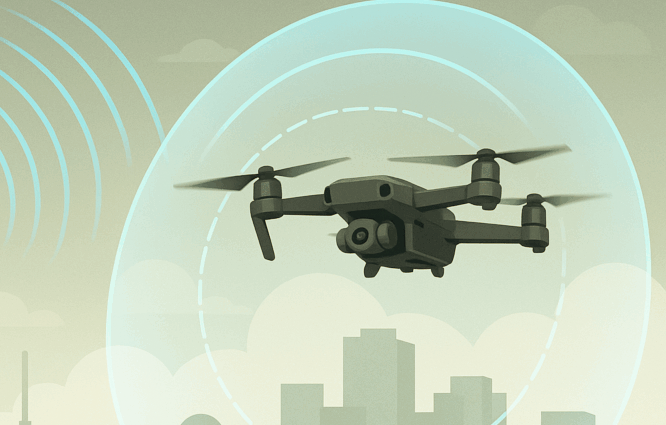
In the rapidly evolving field of Counter-Unmanned Aerial Systems (C-UAS), the effectiveness of a drone jammer is not solely determined by its power output. The signal coverage pattern—the three-dimensional shape of the radio frequency (RF) energy emitted—dictates how, where, and when a drone is neutralized.
Choosing the wrong coverage pattern can create “blind spots” in your defense or inadvertently disrupt friendly communications in adjacent areas. This guide breaks down the primary signal coverage patterns used in drone jamming systems, helping you match the RF footprint to your specific operational requirements.
The Two Fundamental Categories
Before diving into specific patterns, it is crucial to understand that all jammer antennas fall into two broad categories based on how they propagate energy:
-
Omnidirectional: Radiates power equally in all directions (360 degrees) on a horizontal plane.
-
Directional: Focuses power into a specific “beam,” covering a limited angle (e.g., 30 to 120 degrees).
However, modern systems often blend these concepts. Below is a detailed comparison of the standard coverage patterns used in the field today.
Comparative Analysis of Coverage Patterns
The following table outlines the most common signal patterns found in drone jammer modules and systems.
| Coverage Pattern | Typical Beamwidth | Best Use Case | Advantages | Disadvantages |
|---|---|---|---|---|
| Omnidirectional | 360° Horizontal / Varies Vertically | Perimeter Protection: Securing static assets like prisons, military bases, or stadiums. | No tracking required; jams threats from any direction.Simplifies system design (fewer moving parts).Ideal for creating a “bubble” of denial. | High risk of interfering with friendly assets in all sectors.Wastes energy on empty airspace.Susceptible to the “Near-Far” problem (desensitizing your own sensors). |
| Directional (Sectorized) | 60° to 120° Horizontal | Long-Range Interdiction: Mounted on vehicles or tripods to engage specific threat axes. | Higher gain increases effective jamming range.Reduces collateral interference to the sides and rear.More efficient power usage. | Requires a detection system to point the beam.Limited coverage area; cannot handle threats from multiple directions simultaneously without multiple units. |
| Pencil Beam (Highly Directional) | 5° to 30° Horizontal | Targeted Takeover/Disruption: Used in drone “guns” or precision-guided jammers. | Extremely high EIRP (Effective Isotropic Radiated Power) at the focal point.Minimal risk of interfering with nearby friendly forces.Difficult for the target drone to detect the source (low probability of intercept). | Requires precise aiming (optical sight or tracking radar).Ineffective against fast-moving targets without an auto-tracking gimbal. |
| Hemispherical / Dome | 360° x 180° (Full Sphere) | Top-Down Protection: Protecting assets from drones attacking vertically (e.g., dropping payloads). | Covers the “overhead” threat that flat omni patterns miss.Essential for protecting open-air facilities like oil refineries or public events. | Complex antenna design (usually requires multiple elements).Can cause significant ground interference if not carefully nulled. |
| Steerable Nulling / Adaptive | Dynamic (Software Defined) | Complex Spectrum Environments: Military operations where maintaining friendly comms is critical. | Creates “nulls” (areas of no signal) to protect friendly receivers.Dynamically adapts to changing threat locations. | Extremely high cost and complexity.Requires sophisticated software and digital RF memory (DRFM) technology. |
Key Technical Considerations
When evaluating these patterns for your drone jammer system, consider the following technical factors that impact real-world performance:
1. The Vertical Plane (Elevation)
Many buyers only look at the horizontal (azimuth) coverage, forgetting that drones fly overhead. A standard omnidirectional antenna typically has a donut-shaped pattern, which has a “null” (weak spot) directly above the antenna. For threats like quadcopters dropping explosives, you need a hemispherical pattern or multiple antennas angled upward to cover the zenith.
2. Beamwidth vs. Gain Trade-off
There is an inverse relationship between beamwidth and gain.
-
A wide beam (e.g., 120°) covers more area but has lower gain, meaning shorter range.
-
A narrow beam (e.g., 30°) has high gain and long range but covers less area.
System designers must choose the balance that fits their “kill chain.”
3. Multi-Band Pattern Consistency
A common technical flaw in jammer modules is that the antenna pattern changes across different frequency bands.
-
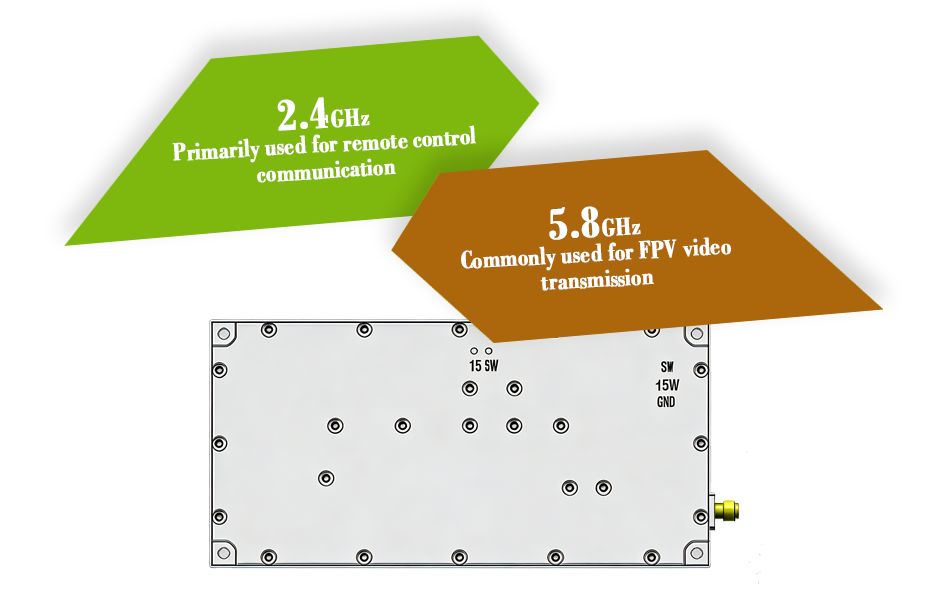
A single antenna might provide a 90° pattern at 2.4 GHz but pinch down to a 30° pattern at 5.8 GHz, creating a coverage gap for the drone’s video link.
-
The Fix: Insist on radiation pattern graphs for each frequency band the module covers to ensure uniform coverage.
4. Polarization
Signal patterns also have a polarization (vertical, horizontal, or circular). Most consumer drones use linear polarization (often vertical for control). If your jammer’s polarization is mismatched (e.g., horizontal), you can lose 20dB or more of signal strength (a 100x reduction in power), drastically cutting your effective range.
Choosing the Right Pattern for the Mission
There is no “one-size-fits-all” solution. The optimal pattern depends entirely on the threat model:
-
Static Defense (e.g., Prison): An Omnidirectional or Hemispherical pattern is usually best to create a no-fly zone over the facility, preventing contraband drops.
-
Mobile Convoy Protection: Directional or Sectorized patterns are preferred. You want to jam threats coming from the front and rear of the convoy while preserving your own side-looking comms.
-
VIP Protection / Public Events: A mix of Directional (for known approach paths) and Hemispherical (for overhead paparazzi drones) is often required.
Conclusion
Understanding signal coverage patterns is essential for deploying an effective drone jammer. By moving beyond simple “range” specs and analyzing the three-dimensional shape of the RF beam—including its gain, beamwidth, and polarization—you can design a system that maximizes neutralization probability while minimizing fratricide of your own electronic systems.
