

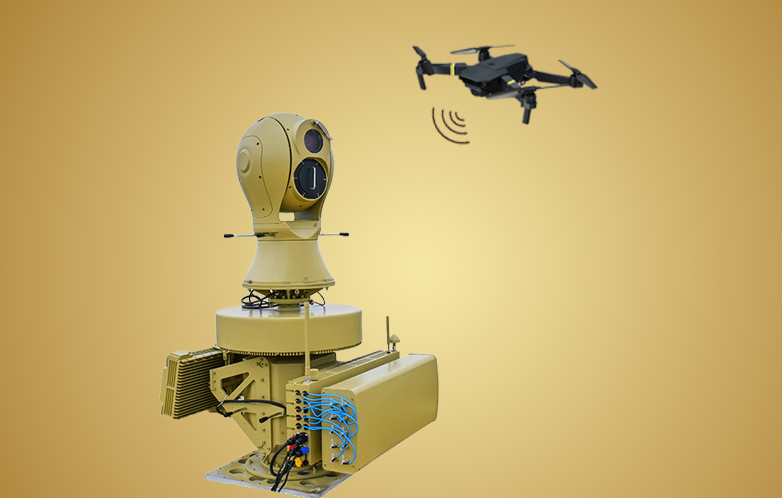

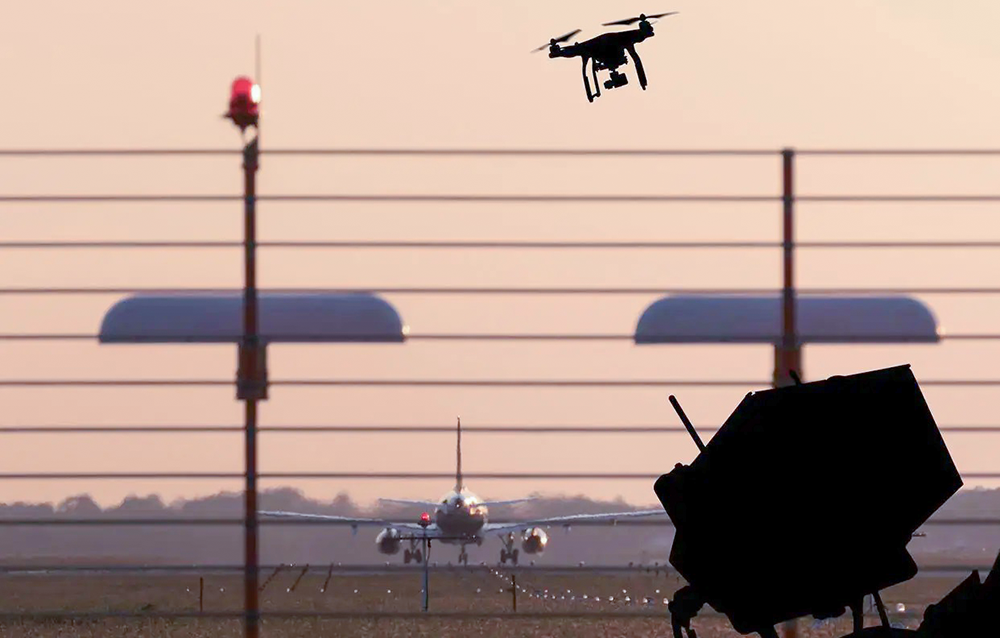
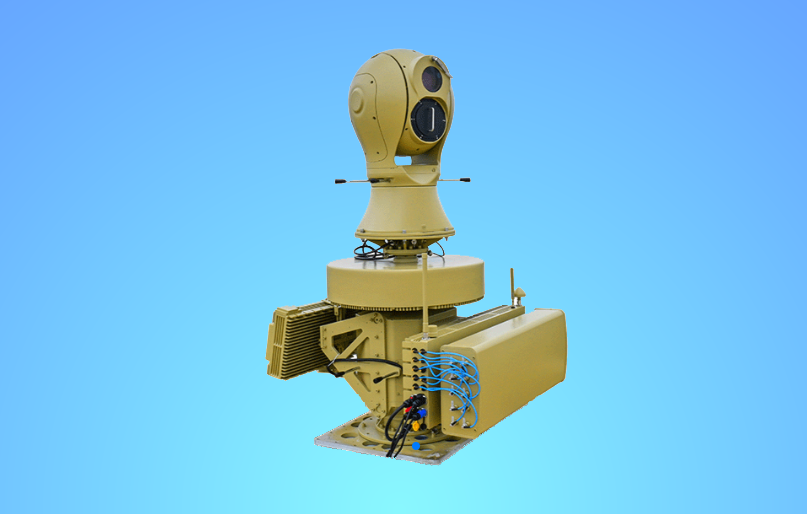

One of the most common questions in the Counter-UAS (C-UAS) industry is deceptively simple: *”If I buy a 100-watt jammer, how far will it reach?”* The answer is never straightforward because the relationship between power output and effective jamming range is not linear. It is governed by the unforgiving laws of RF physics.
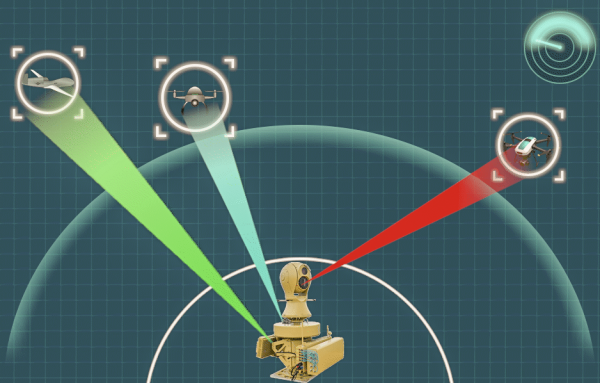
Understanding this relationship is critical for security integrators and end-users who need to set realistic expectations for drone defense perimeters. This article demystifies how wattage translates into distance and explores the other variables that are just as important as raw power.
The Inverse Square Law: Why Doubling Power Doesn’t Double Range
The most important concept to grasp is the Inverse Square Law. In free space, as a radio wave travels away from its source, its power density decreases proportionally to the square of the distance.
What does this mean for drone jamming?
If you double the distance from the jammer antenna to the drone, the signal strength at the drone’s location drops to one-quarter (1/4) of its original value.
This has a direct implication for power requirements. To double the effective jamming range of a system, you theoretically need to quadruple (4x) the transmitter power output.
Example:
-
A 20W jammer module effectively disrupts a drone at 1,000 meters.
-
To reach 2,000 meters with all other factors identical, you would need an 80W module, not a 40W module.
This exponential power demand explains why extremely long-range stationary jammers quickly become large, expensive, and power-hungry.
The Jamming Equation: J/S Ratio
The effectiveness of jamming is determined by the Jamming-to-Signal ratio (J/S) . The drone’s receiver is trying to listen to the pilot’s remote control signal. The jammer’s job is to scream louder than that remote control.
J/S = (Jammer Power) – (Path Loss) – (Control Link Power)
For a drone to lose connection and trigger a failsafe (Return-to-Home or Land), the jammer’s signal must be 10 to 20 dB stronger than the control signal at the drone’s receiver antenna.
Because the pilot’s control signal also suffers from path loss (it gets weaker as the drone flies further away), jamming is actually easier at longer drone distances from the pilot, but harder at longer distances from the jammer.
Why a 50W Module Isn’t Always Better Than a 20W Module
While wattage is a primary factor, three other elements dramatically influence whether that power actually reaches the target:
1. Antenna Gain (dBi)
Power output (Watts) is measured at the amplifier output connector. Antenna gain is what shapes that raw power into a useful beam. This is called Effective Isotropic Radiated Power (EIRP) .
-
Omnidirectional Antenna (3 dBi): Spreads 50W in a 360-degree bubble. The power density drops off very quickly. Effective for close-in protection.
-
Directional Panel Antenna (14 dBi): Focuses 50W into a narrow 30-degree beam. This creates a much higher EIRP in that specific direction, effectively extending range by a factor of 3x to 4x compared to an omni antenna using the same module.
2. Line-of-Sight and Fresnel Zone
Drone jamming relies heavily on Line-of-Sight (LoS) . RF energy in the 2.4 GHz and 5.8 GHz bands behaves similarly to visible light; it does not bend around hills or penetrate thick concrete walls effectively.
If your 100W stationary jammer is mounted behind a thick forest canopy or a metal building parapet, the drone on the other side might not even register the interference. The Fresnel Zone (the elliptical area around the direct path) must be at least 60% clear of obstructions for optimal signal propagation.
3. Drone Receiver Sensitivity
Not all drones are created equal. A consumer DJI drone has a relatively sensitive receiver designed for long-range video. However, a custom-built FPV racing drone or a military-grade platform often uses front-end filtering and high-dynamic-range receivers. These can tolerate higher noise floors before dropping the link.
In practice: Jamming a hobby drone at 1km with 20W is easy. Jamming a hardened, frequency-hopping military drone at the same distance might require 200W or more.
Power Requirements by Use Case
Here is a realistic, field-based breakdown of what power output achieves in a typical open-field scenario (assuming a 10 dBi directional antenna):
| Power Output (Module) | Realistic Jamming Radius | Typical Application |
|---|---|---|
| 5W – 10W | 300m – 500m | Portable body-worn unit, VIP close protection. |
| 20W – 50W | 800m – 1.5km | Man-portable rifle systems, temporary event perimeter. |
| 100W – 200W | 2km – 4km | Fixed-site perimeter (prison, stadium). |
| 500W+ | 5km – 10km+ | Military base defense, airport wide-area denial. |
The Heat Problem: Why High Power Needs Cooling
There is an inescapable trade-off in embedded modules: RF efficiency. A typical high-power amplifier (HPA) is only about 40% to 50% efficient.
-
Input: 100W DC Power
-
RF Output: 45W
-
Heat Generated: 55W
That 55W of heat must be removed immediately or the module will burn out. This is why stationary systems with high power output require massive heatsinks, forced-air fans, or even liquid cooling. Portable jammers are limited not just by battery capacity, but by the user’s ability to hold a hot device safely.
Conclusion: Think in Systems, Not Just Watts
When evaluating a drone jammer, focusing solely on the advertised wattage is a common pitfall. Power output is the engine, but antenna selection, mounting height, and line-of-sight are the steering wheel and transmission.
To maximize jamming range, follow this hierarchy:
-
Maximize Antenna Gain: A 20W module with a high-gain sector antenna will outperform a 100W module with a rubber duck antenna every single time.
-
Elevate the Antenna: Height solves line-of-sight and Fresnel zone issues better than doubling the power.
-
Increase Power Last: Only after optimizing the first two factors should you upgrade to a higher wattage module.
Understanding the physics of the inverse square law ensures that when you do invest in higher power, you understand exactly what that extra wattage is buying you—and what it isn’t.
