


Drone jamming is one of the most commonly used methods for countering unauthorized UAV activity. By transmitting interference signals, a drone jammer module can disrupt the communication, navigation, or video transmission links between a drone and its operator.

A key question for many system integrators and security users is: how much power is required for effective drone jamming? The answer depends on several technical and environmental factors.
Typical Power Levels for Drone Jammers
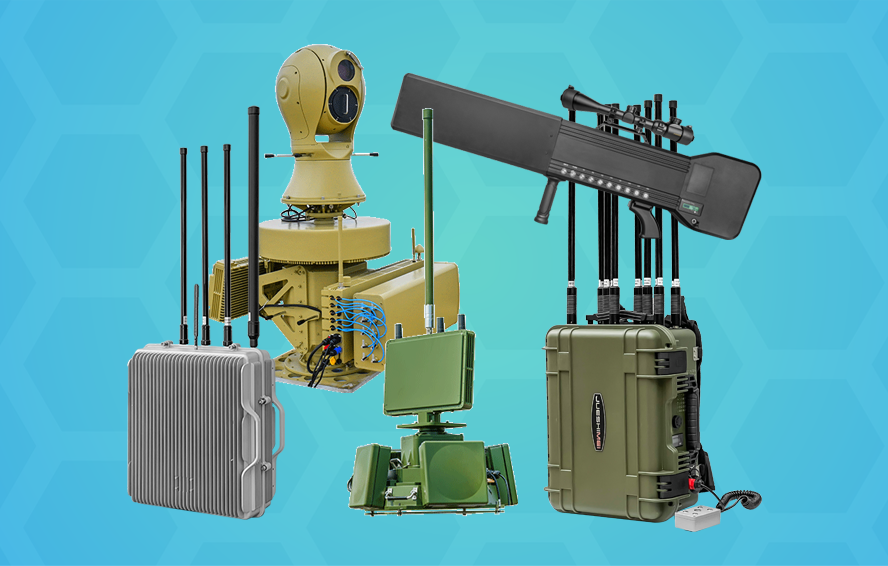
Drone jamming devices are usually classified by their RF output power. Common power levels include:
-
10W–30W: Suitable for short-range protection and compact portable systems.
-
50W–100W: Ideal for medium-range coverage and vehicle-mounted solutions.
-
100W and above: Used in fixed anti-drone systems requiring larger coverage areas.
Higher power generally allows the jammer to interfere with drone signals over longer distances, but system design and antenna configuration also play an important role.
Key Factors That Affect Jamming Effectiveness
Jamming Distance
The farther the drone is from the jammer, the more power is needed to disrupt its control or navigation signals. Long-range protection typically requires higher output power.
Frequency Bands
Most commercial drones operate on 2.4 GHz, 5.8 GHz, and GNSS navigation bands. Some frequencies require stronger interference signals, especially when targeting multiple communication links simultaneously.
Antenna Design
A high-gain directional antenna can focus RF energy toward the drone, increasing effective range without significantly increasing power consumption.
Environment
Buildings, terrain, and other obstacles can weaken RF signals. In complex environments, higher power or multiple jamming units may be required.
Finding the Right Balance
While higher power can extend jamming range, it also increases energy consumption and heat generation. Modern GaN-based drone jammer modules improve efficiency, allowing compact systems to deliver strong interference performance.
For most applications, selecting the correct combination of power level, antenna design, and frequency coverage is more important than simply choosing the highest power available.
Conclusion
The power level needed for effective drone jamming depends on factors such as protection distance, operating frequency, and deployment environment.
Low-power modules work well for portable solutions, while high-power systems are better suited for fixed installations protecting large areas. Choosing the right configuration ensures reliable counter-drone protection while maintaining system efficiency.
