


Introduction
The counter-drone landscape is a high-stakes game of cat and mouse. Today’s threat might be a consumer quadcopter streaming video over standard 2.4 GHz. Tomorrow’s threat could be a custom-built FPV drone operating on a non-standard frequency band, or a swarm using adaptive frequency hopping. In this environment, buying a fixed, monolithic jammer is like buying a smartphone you can never update—it works fine until the world moves on, and then it becomes an expensive paperweight.

For security integrators and critical infrastructure operators, the answer lies in modular architecture. Modular drone jamming systems offer a scalable, future-proof approach to layered defense, allowing you to adapt to evolving threats without ripping out and replacing your entire security infrastructure.
What is a Modular Drone Jamming System?
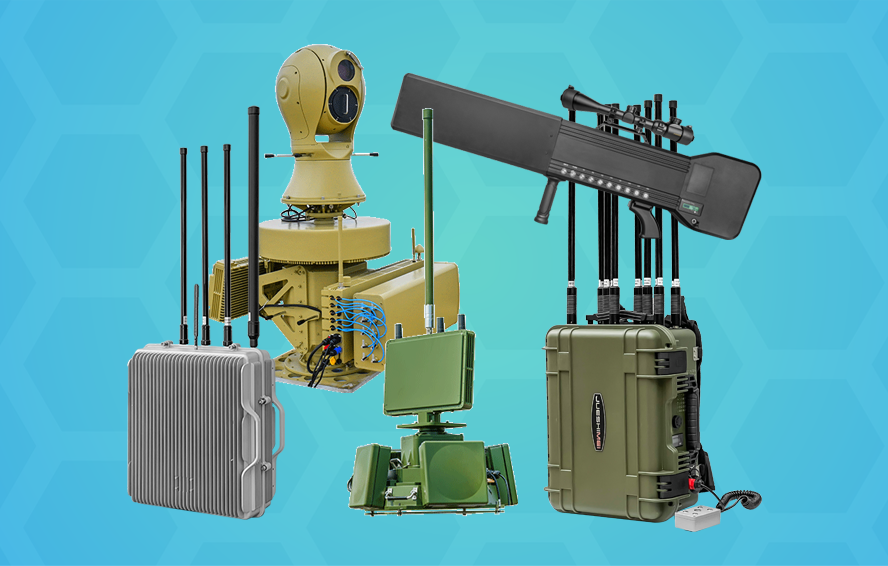
Unlike traditional jammers where all RF components are hard-wired into a single sealed chassis, a modular system separates the core functions into discrete, interchangeable units. Think of it as a professional audio mixing board or a server rack. The system typically consists of:
-
A Central Control Unit: The brains of the operation, handling power distribution, thermal management, and communication with external C2 (Command and Control) software.
-
Hot-Swappable RF Modules: Individual, self-contained amplifiers and signal generators dedicated to specific frequency bands (e.g., 433 MHz, 915 MHz, 2.4 GHz, 5.8 GHz, GNSS L1/L2).
-
Antenna Interface: A unified connection point that allows the combined or individual output of these modules to be routed to directional or omnidirectional antennas.
The Power of Layered Defense Architecture
The term “layered defense” is often used loosely in security, but in the context of modular jamming, it has a very specific technical meaning. It refers to the ability to activate the right tool at the right range.
-
The Outer Layer (GNSS Denial): At maximum range, the system might activate only the GNSS module. This disrupts the drone’s navigation and ability to follow a pre-programmed mission path without necessarily severing the video link. It creates a navigational “fog” rather than a full communication “wall.”
-
The Mid Layer (Command Link Disruption): As the drone approaches a protected perimeter, the system layers in the specific ISM band modules (2.4 GHz or 5.8 GHz) based on real-time spectrum analysis. This severs the pilot’s control.
-
The Inner Layer (Full Spectrum Protection): For a verified high-threat intrusion, the system engages all available modules simultaneously, creating a multi-spectrum shield directly over the protected asset.
This graduated response is critical for minimizing collateral interference in urban or industrial environments. A modular system allows the security team to fine-tune this response profile module by module.
Key Business Benefits of Scalable Architecture
Why should businesses and governments invest in modularity over a cheaper, fixed alternative?
1. Future-Proofing and Band Agility
The electromagnetic spectrum is not static. New drone protocols emerge every year, and legacy jammers often cannot touch frequencies like 1.2 GHz used by long-range FPV hobbyists. With a modular system, you don’t replace the entire unit; you simply slide out the old 2.4 GHz card and slide in a new one that covers the emerging threat band. This protects the initial capital investment for years longer.
2. Field Maintainability and Reduced Downtime
In a fixed system, a single blown amplifier component often means shipping the entire 50-pound unit back to the factory for weeks of repair. In a modular system, if the 5.8 GHz module fails, the rest of the system remains operational. A technician can swap the faulty module in under 60 seconds using a screwdriver, restoring full capability immediately. For 24/7 critical sites like data centers or power plants, this hot-swap capability is non-negotiable.
3. Customization Without Custom Engineering
Every site has a unique RF signature. A stadium needs different power levels than a border checkpoint. Modular systems allow you to “build-a-bear” your jammer configuration. You can populate the chassis with high-power amps for a rural perimeter or low-power precision modules for a dense city center, all using the same core infrastructure.
4. Cost-Effective Scaling
You can start with a baseline configuration covering the most common drone bands. As budget allows, or as the threat landscape evolves, you can purchase additional modules to add capacity. This transforms a capital expense (CapEx) shock into a manageable, phased operational upgrade.
Design Considerations for Integrators
When selecting a modular C-UAS platform, look beyond the module count. Evaluate the backplane bandwidth. The chassis must be able to handle the combined data and power throughput of all modules operating at 100% duty cycle. Additionally, ensure the software supports module fingerprinting—the ability to automatically recognize and configure newly inserted modules without manual programming.
Conclusion
The era of the static, brute-force jammer is ending. The drone threat is agile, diverse, and constantly iterating. Our defense architectures must mirror that agility. Modular drone jamming systems provide the scalable, maintainable, and economically sensible framework required for layered defense. They ensure that your counter-UAS posture is not just strong today, but ready for the threats of tomorrow—without requiring a complete system overhaul. In a world where the only constant is change, modularity isn’t a feature; it’s a strategic imperative.
