



Selecting the right drone jammer form factor is just as critical as choosing the correct frequency bands or power output. A device that excels at protecting a forward operating base may be completely impractical for a mobile executive protection detail. Conversely, a lightweight handheld unit is useless for defending a stationary critical infrastructure site against persistent surveillance.
Understanding the operational trade-offs between portable, fixed, and vehicle-mounted jammers allows security managers to architect a layered defense that balances mobility, power, and coverage. Below, we break down the three primary deployment categories.
1. Portable Drone Jammers (Handheld/Gun-Style)

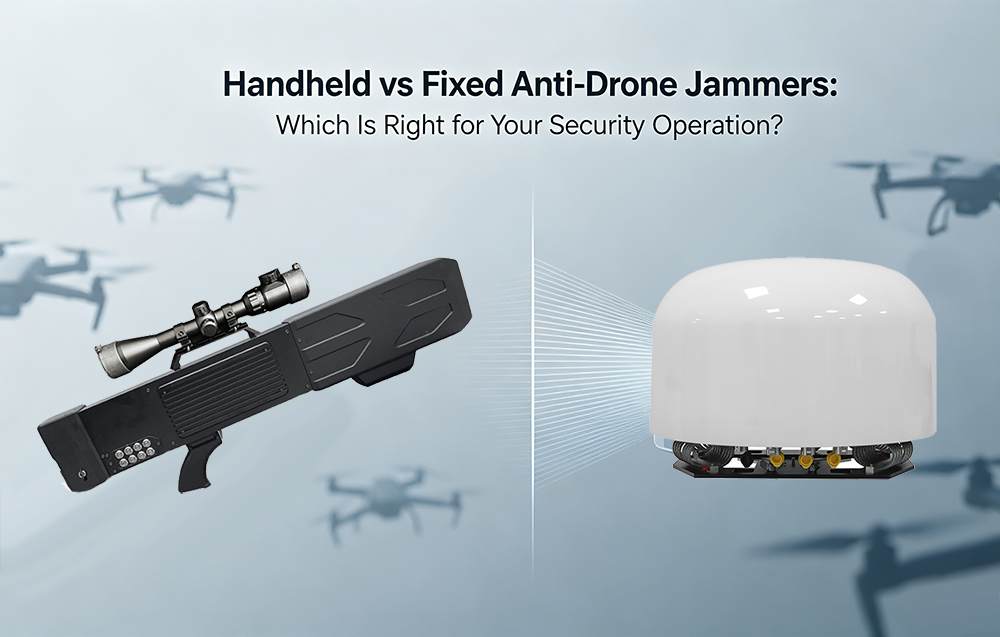
These are the most recognizable form of counter-UAS technology, often resembling a rifle with directional antennas. They are designed for single-operator carry and point-and-shoot operation.
Pros:
-
Ultimate Mobility: Portable jammers can be deployed anywhere a person can stand. They are ideal for rapid response, moving motorcades, tactical law enforcement entries, and events where the perimeter shifts constantly.
-
Tactical Precision: Most handheld units use directional antennas. This allows the operator to isolate a specific drone in the sky without blanketing the entire area in RF noise, minimizing collateral disruption to local WiFi or communications.
-
Low Logistical Footprint: They require no installation, mounting hardware, or power cabling. They run on rechargeable battery packs and can be stored in a vehicle trunk.
Cons:
-
Limited Range and Endurance: Due to size and battery constraints, effective jamming range is typically between 500 meters and 2 kilometers. Battery life is usually limited to 1-2 hours of continuous active jamming.
-
Operator Dependency: Effectiveness relies heavily on the skill of the user. Spotting a small drone against a bright sky or at night and maintaining aim long enough to trigger a failsafe landing requires training and visual acquisition.
-
Power Constraints: They often struggle against high-power, long-range fixed-wing drones that operate at the edge of the portable unit’s transmit capability.
Best Use Cases:
-
VIP Protection (Presidential/Executive motorcades)
-
Tactical SWAT/Police Operations
-
Border Patrol Rapid Response
-
Temporary Event Overwatch (Marathons, Open-Air Rallies)
2. (Stationary/Omnidirectional)

Fixed-site jammers are permanent installations mounted on rooftops, towers, or perimeter poles. They are the heavy artillery of drone defense, designed for 24/7 autonomous or remotely triggered operation.
Pros:
-
Continuous Coverage: These systems are hardwired to mains power or robust backup generators, allowing for indefinite operation. They provide a persistent “RF dome” over a defined asset.
-
Superior Range and Power: Without weight restrictions, fixed jammers utilize larger amplifiers and high-gain omnidirectional or sector antennas. Effective ranges of 3 to 5+ kilometers are standard.
-
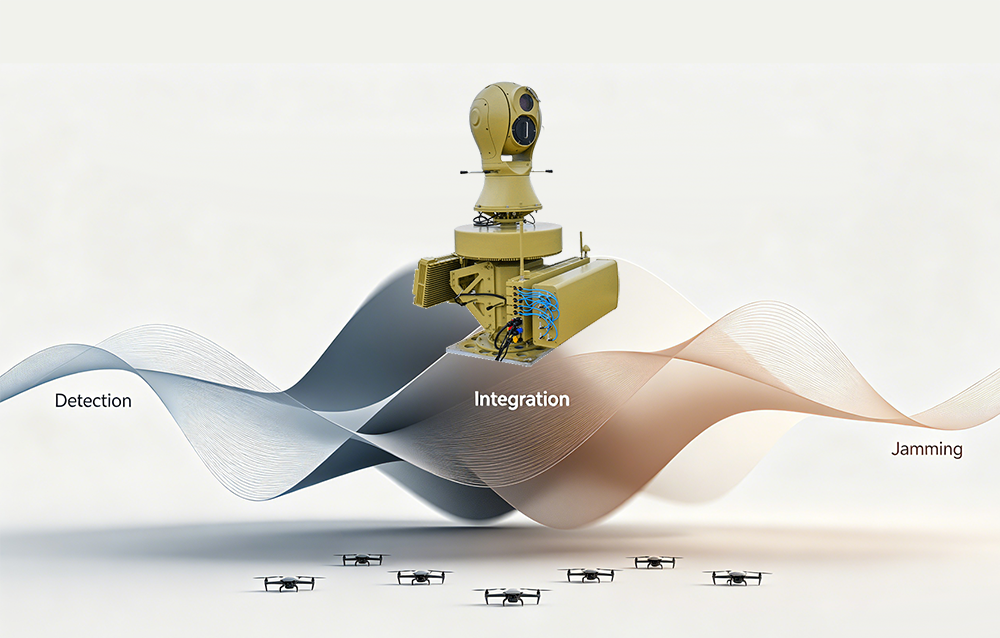
Integration with Radar: Fixed jammers are typically integrated into a wider security ecosystem. When a radar detects a drone, the jammer activates automatically, creating a seamless, lights-out defense shield.
Cons:
-
Lack of Agility: The coverage area is static. The jammer cannot move to chase a drone or adjust to a threat outside the pre-defined antenna pattern without physically repositioning the hardware.
-
High Installation Cost: Deployment involves civil works, tower climbing, complex RF cabling, and spectrum licensing analysis. It is a capital-intensive project, not an off-the-shelf purchase.
-
Collateral Interference Risk: To cover a 360-degree area, fixed jammers often rely on higher power and wider beams, which increases the risk of interfering with legitimate nearby wireless services if not carefully tuned.
Best Use Cases:
-
Critical Infrastructure Security (Nuclear Plants, Power Substations, Water Treatment)
-
Airports and Seaports Perimeter Defense
-
Correctional Facilities (Preventing Contraband Drops)
-
Data Centers and Corporate Campuses
3. Vehicle-Mounted Drone Jammers

This category bridges the gap between the firepower of a fixed site and the mobility of a handheld unit. Systems are integrated into the roof rack, truck bed, or interior of a tactical vehicle with antennas exposed externally.
Pros:
-
Mobile Power Projection: A vehicle can house larger batteries and alternators, feeding high-power amplifiers that rival fixed-site performance but on wheels. This creates a movable exclusion zone perfect for convoys.
-
Rapid Redeployment: Unlike a fixed tower, a vehicle jammer can reposition to the most likely threat vector within minutes.
-
Operator Comfort and Safety: Operators can manage the system from inside a shielded vehicle cabin, protected from weather, RF exposure, and potential kinetic threats.
Cons:
-
Terrain Limitations: The jammer is only effective where the vehicle can drive. It cannot cover dense forests, pedestrian-only zones, or the upper floors of a building unless the antenna mast is elevated.
-
Power Management: While more robust than batteries, prolonged jamming while the engine is off can drain the vehicle battery rapidly, potentially stranding the asset.
-
Vehicle Profile: The presence of large antenna arrays on a vehicle eliminates the element of stealth. It clearly identifies the vehicle as a high-value counter-UAS asset.
Best Use Cases:
-
Military Convoy Protection
-
Mobile Air Defense for Maneuver Units
-
Law Enforcement Surveillance During Civil Unrest
-
Protection of Temporary Forward Operating Bases
Conclusion: A Layered Approach
There is no single “best” form factor. A comprehensive counter-drone strategy almost always involves a layered defense. A fixed jammer secures the 3-kilometer ring around the facility. A vehicle-mounted patrol unit extends that bubble along the main access road. And a portable jammer stands ready at the entry gate to handle the “leakers” that get too close. Selecting the right mix ensures that when a new drone protocol emerges, your defensive posture is not only technologically current but also tactically positioned for success.
